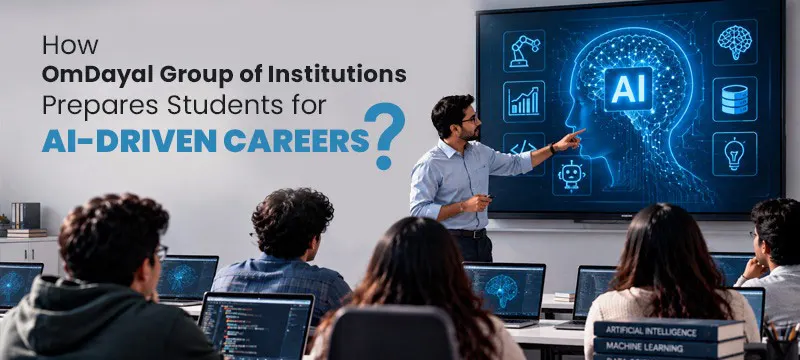
Artificial Intelligence is no longer limited to research laboratories or science-fiction stories. From healthcare and banking to education, manufacturing, transport and digital commerce, AI and Machine Learning are transforming how organisations operate and make decisions. As a result, the demand for professionals who can understand data, develop intelligent systems and solve complex problems is steadily increasing.
For students completing Class 12, a B.Tech in Artificial Intelligence and Machine Learning offers an opportunity to enter this expanding field. However, earning a degree alone is not enough. Students need a strong technical foundation, practical exposure, analytical ability, communication skills and the confidence to adapt to emerging technologies.
The B.Tech programme in Artificial Intelligence and Machine Learning at OmDayal Group of Institutions is designed to help students build these capabilities and prepare for careers in an AI-driven world.
Building a Strong Foundation in Engineering and Computing
Successful AI professionals require more than knowledge of a few software tools. They need to understand the principles that make intelligent technologies work.
The B.Tech in AI and ML programme helps students develop a foundation in areas such as:
- Programming and computational thinking
- Data structures and algorithms
- Mathematics and statistics
- Database management
- Computer networks
- Machine Learning
- Artificial Intelligence
- Data analysis and visualisation
These subjects help students understand how data is collected, processed and used to create intelligent solutions. A strong foundation also enables them to learn advanced technologies more confidently as they progress through the programme.
OmDayal Group of Institutions offers B.Tech programmes in Artificial Intelligence and Machine Learning and other engineering disciplines. Its engineering courses are approved by AICTE and affiliated with MAKAUT, while the institution is also NAAC accredited.
Encouraging Practical and Application-Oriented Learning
AI and Machine Learning cannot be mastered through textbooks alone. Students must learn how to apply concepts to real situations.
Practical assignments, laboratory sessions, programming exercises and project-based learning encourage students to move beyond theory. While working on projects, students may explore problems involving data classification, prediction, pattern recognition, automation or intelligent decision-making.
This form of learning teaches students how to:
- Define a real-world problem
- Identify and organise relevant data
- Select an appropriate computational approach
- Develop and test a working solution
- Analyse the accuracy of the outcome
- Present their findings clearly
The process also teaches an important professional lesson: an AI model is rarely perfect in its first version. Students must test, evaluate and improve their work continuously.
Developing Programming and Data Skills
Programming is one of the most important skills for students aspiring to build a career in AI and Machine Learning. However, learning programming is not simply about memorising syntax. It involves developing logical thinking and learning how to divide a complex problem into manageable steps.
Through consistent academic practice, students can strengthen their ability to write, test and improve programs. They also learn how algorithms, databases and data structures contribute to the development of AI-based applications.
Since Machine Learning depends heavily on data, students must understand how to collect, clean, organise and interpret information. These abilities can prepare them for roles that require both technical knowledge and evidence-based decision-making.
Strengthening Analytical and Problem-Solving Abilities
The purpose of an engineering education is not merely to provide ready-made answers. It should train students to ask the right questions.
AI-related problems often involve incomplete data, multiple possible solutions and changing conditions. Students must compare different approaches and understand why one solution may perform better than another.
The academic environment at OmDayal Group of Institutions aims to develop analytical, communication and problem-solving abilities alongside technical knowledge. Such skills are valuable not only for AI careers but also for higher education, entrepreneurship and interdisciplinary research.
Connecting Classroom Learning with Industry Expectations
Technology companies look for graduates who can translate academic knowledge into practical outcomes. For this reason, students benefit from understanding professional expectations before completing their degree. Training, internships, technical activities and placement preparation can introduce students to workplace practices and emerging career requirements. OmDayal Group of Institutions has a dedicated Training and Placement Cell that provides students with a platform to present their capabilities to recruiters. Training and Placement at OmDayal
Industry-oriented preparation can help students understand:
- How technical interviews are conducted
- How to create a professional résumé
- How to explain an academic project
- How to work effectively in a team
- How to communicate technical ideas
- How to approach aptitude and coding assessments
This combination of technical and professional preparation can support a smoother transition from college to employment.
Preparing Students for Diverse AI Career Opportunities
Graduates with relevant knowledge and skills may explore career opportunities in several areas, including:
- Artificial Intelligence Engineering
- Machine Learning Engineering
- Data Analysis
- Data Science
- Software Development
- Business Intelligence
- AI Testing and Quality Assurance
- Automation
- Cloud-based AI solutions
- Research and higher education
AI expertise is also becoming relevant across sectors such as healthcare, finance, education, agriculture, manufacturing, logistics, cybersecurity and e-commerce. Therefore, students are not restricted to working only in conventional technology companies.
Actual career outcomes depend on a student’s academic performance, practical ability, internships, portfolio, communication skills and continued learning.
Promoting Communication, Teamwork and Professional Confidence
AI solutions are rarely created by one person working alone. Engineers frequently collaborate with developers, analysts, designers, managers and domain specialists. They must be able to explain complex ideas to people who may not have a technical background.
Group projects, presentations, workshops and collaborative activities help students strengthen communication, leadership and teamwork. These skills are particularly important during interviews and in professional environments where employees must contribute to multidisciplinary teams.
Introducing Responsible and Ethical Use of AI
As AI becomes more powerful, ethical awareness becomes increasingly important. Intelligent systems may influence hiring, lending, healthcare, education and public services. Poorly designed systems can produce inaccurate or biased outcomes.
Future engineers must therefore learn to consider:
- Data privacy and security
- Bias in algorithms and datasets
- Transparency in automated decisions
- Responsible use of personal information
- Social consequences of automation
- Human accountability in AI systems
An academically responsible approach helps students understand that innovation must be combined with fairness, safety and social responsibility.
Encouraging Continuous Learning
The field of Artificial Intelligence changes rapidly. Tools that are popular today may be replaced or significantly improved in the future. Therefore, the most valuable capability students can develop is the ability to keep learning.
A strong understanding of fundamentals allows graduates to adapt to new programming languages, algorithms, platforms and industry requirements. Students who regularly read, experiment and build independent projects are better positioned to remain relevant throughout their careers.
A Reassuring Choice for Students and Parents
For students, the B.Tech in AI and ML offers the excitement of working with emerging technologies and solving meaningful problems. For parents, the programme represents an education that combines engineering fundamentals with skills relevant to a technology-led economy.
OmDayal Group of Institutions seeks to create this balance through structured academics, practical learning, professional development and placement support. Its learning environment helps students move from understanding concepts to applying them with confidence.
Conclusion
Preparing for an AI-driven career is not about learning one tool or following a temporary trend. It requires a combination of computing knowledge, mathematical understanding, practical experience, creativity, communication and responsible thinking.
Through its B.Tech in Artificial Intelligence and Machine Learning, OmDayal Group of Institutions helps aspiring engineers develop the academic and professional foundation needed to explore opportunities in the evolving technology landscape. For students who are curious about intelligent systems and motivated to solve real-world problems, the programme can provide a purposeful beginning to their journey in AI and Machine Learning.
FAQs
What does a B.Tech in Artificial Intelligence and Machine Learning teach?
It teaches engineering and computing concepts used to develop systems that can analyse data, identify patterns, make predictions and support automated decisions.
What subjects should AI and ML students learn?
A useful foundation includes programming, mathematics, statistics, data structures, algorithms, databases, computer networks, data analysis and Machine Learning.
How does project-based learning help AI and ML students?
Projects help students apply concepts to practical problems, work with data, test solutions, assess results and improve their work.
What careers can AI and ML graduates pursue?
Depending on their skills and experience, graduates may explore roles in AI engineering, Machine Learning, data analysis, data science, software development, business intelligence, automation, AI testing, research or higher education.
How does OmDayal Group of Institutions support career preparation?
The blog describes training, internships, technical activities, placement preparation and support from a dedicated Training and Placement Cell.
Why are communication and teamwork useful in AI careers?
AI projects often involve people with different areas of expertise. Communication and teamwork help graduates explain ideas and contribute to shared projects.
Why should AI students learn about responsible AI?
AI systems can affect decisions in areas such as healthcare, finance and education. Students should consider privacy, security, bias, transparency and human accountability.
Does an AI and ML degree guarantee a particular job?
No. Career outcomes depend on factors such as academic performance, practical ability, internships, project experience, communication skills and continued learning.