Choosing between BCA (Hons.) and B.Sc Computer Science can be confusing for students interested in technology. While both programmes offer career opportunities in the IT sector, they differ in their learning approach and academic focus. Understanding the key differences in BCA vs B.Sc Computer Science can help students make the right decision after Class 12.
What Is BCA (Hons.)?
BCA (Hons.) is an application-oriented undergraduate programme focused on programming, software development and computer applications. Students generally study subjects such as:
- Programming languages
- Web and application development
- Database management
- Data structures
- Computer networks
- Cloud computing
- Cybersecurity
- Artificial intelligence
The programme is suitable for students who enjoy practical learning, coding and developing technology-based solutions.
What Is B.Sc Computer Science?
B.Sc Computer Science focuses more on the scientific, mathematical and theoretical foundations of computing. Its curriculum commonly includes programming, algorithms, computer architecture, operating systems, discrete mathematics and computational theory.
It is better suited to students who enjoy mathematics, logical reasoning, algorithms and analytical problem-solving.
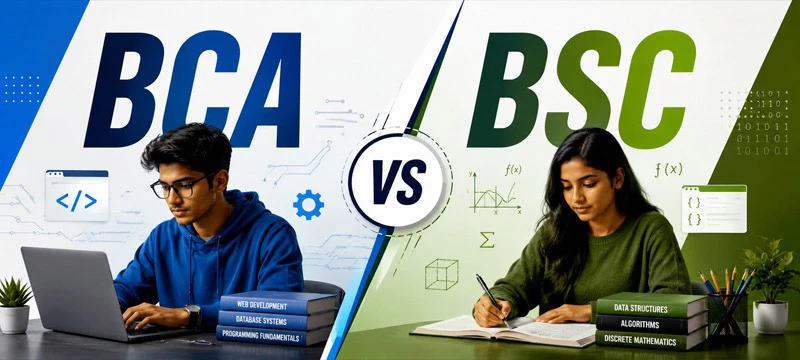
BCA vs B.Sc Computer Science: Key Differences
| Area | BCA (Hons.) | B.Sc Computer Science |
|---|---|---|
| Focus | Computer applications | Computing theory and science |
| Approach | Practical and industry-oriented | Theoretical and analytical |
| Mathematics | Usually moderate | Generally more intensive |
| Best suited for | Software and IT careers | Technical, analytical and research careers |
| Higher studies | MCA, MBA, Data Science | M.Sc, MCA, Data Science |
Career Opportunities
Graduates from either programme may pursue careers as:
- Software developer
- Web or application developer
- Data analyst
- Database professional
- Software tester
- Technical support engineer
- Network administrator
- Cybersecurity professional
Career success depends on programming skills, internships, projects, communication abilities and continuous learning—not only the degree title.
Which Course Should You Choose?
Choose BCA (Hons.) if you prefer practical learning, software development, coding and industry-oriented projects.
Choose B.Sc Computer Science if you enjoy mathematics, algorithms, computing theory and analytical study.
Conclusion
There is no single winner in the BCA vs B.Sc Computer Science comparison. BCA (Hons.) is generally more suitable for students seeking practical and career-oriented IT skills, while B.Sc Computer Science offers a stronger theoretical and mathematical foundation.
Students interested in software, applications and digital technologies can consider pursuing BCA (Hons.) at OmDayal Group of Institutions. Its focus on academic knowledge, practical learning and professional development can help students prepare for opportunities in the evolving technology sector. Prospective students should check the latest eligibility criteria, curriculum and admission details before applying.
FAQs
What is the main difference between BCA (Hons.) and B.Sc Computer Science?
BCA (Hons.) focuses more on practical skills such as programming, software development and computer applications. B.Sc Computer Science places greater emphasis on mathematics, computing theory, algorithms and scientific concepts.
Which is better: BCA (Hons.) or B.Sc Computer Science?
Neither programme is universally better. BCA (Hons.) may suit students interested in practical IT skills and software development, while B.Sc Computer Science may be preferable for those who enjoy mathematics, theory and analytical learning.
Can students from any stream apply for BCA (Hons.)?
Many colleges accept BCA applicants from Science, Commerce and Humanities backgrounds. At OmDayal Group of Institutions, students from any stream may apply, subject to the latest admission guidelines.
Is Mathematics compulsory for B.Sc Computer Science?
Most colleges require students to have studied Mathematics in Class 12. Some institutions may also require Physics or Computer Science and a specified minimum percentage.
Is Mathematics compulsory for BCA (Hons.)?
Mathematics is not compulsory for BCA (Hons.) at many institutions. However, eligibility requirements vary, so students should check the admission criteria of their chosen college.
What career opportunities are available after BCA (Hons.)?
BCA graduates can pursue roles such as software developer, web developer, application developer, software tester, database professional, technical support engineer and network administrator.
What jobs can students get after B.Sc Computer Science?
B.Sc Computer Science graduates may work in software development, data analysis, systems administration, networking, cybersecurity, technical support and research-oriented roles.
What is the starting salary after BCA or B.Sc Computer Science?
Fresh graduates in India may receive entry-level salaries of approximately ₹3–6 LPA. Actual salaries depend on technical skills, internships, projects, job role, employer, location and communication abilities.
Which course has better future prospects?
Both programmes offer promising prospects in software development, cloud computing, cybersecurity, data science, artificial intelligence and machine learning. Long-term success depends largely on skills, practical experience and continuous learning.
What higher-study options are available after these courses?
BCA graduates may pursue MCA, MBA, M.Sc Data Science or industry certifications. B.Sc Computer Science graduates can consider M.Sc Computer Science, MCA, Data Science and other specialised technology programmes.
Is BCA (Hons.) suitable for students who want to become software developers?
Yes. Its application-oriented curriculum makes BCA (Hons.) a suitable choice for students interested in coding, application development and software-based careers.
Why consider BCA (Hons.) at OmDayal Group of Institutions?
OmDayal Group of Institutions combines academic learning with practical training and professional development, helping students prepare for opportunities in the evolving IT and technology sectors.