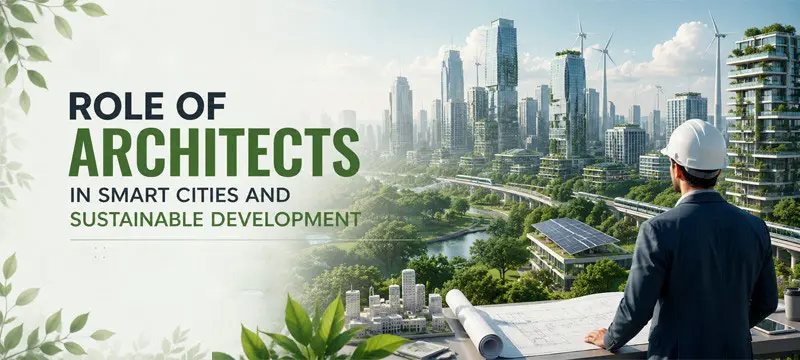
Cities are growing faster than ever. With increasing population, rising demand for housing, pressure on natural resources, traffic congestion, pollution, and climate change, the future of urban living depends on how intelligently we design our cities. This is where architects play a powerful role.
The role of architects in smart cities and sustainable development is no longer limited to designing beautiful buildings. Today, architects are problem-solvers, urban thinkers, sustainability planners, and design innovators. They create spaces that are not only functional and aesthetically attractive but also environmentally responsible, energy-efficient, inclusive, and future-ready.
India’s Smart Cities Mission was launched to improve the quality of urban life through efficient services, strong infrastructure, inclusivity, and sustainable solutions. This vision has opened new opportunities for architects who can combine creativity with technology, sustainability, and urban planning.
What Makes a City Smart and Sustainable?
A smart city is not just a city with digital technology. It is a city that uses planning, innovation, infrastructure, and citizen-focused design to improve everyday life. A truly smart city focuses on better mobility, clean environment, efficient energy use, safe public spaces, water management, waste management, digital governance, and quality housing.
Sustainable development means meeting today’s needs without damaging the ability of future generations to meet theirs. In architecture, this means designing buildings and cities that reduce environmental impact, use resources wisely, and create healthier living conditions.
Therefore, architects in smart cities and sustainable development work at the intersection of design, environment, technology, and human comfort.
Why Architects Are Important in Smart City Development
Architects understand how people interact with spaces. They study climate, materials, movement, culture, land use, energy consumption, and social needs before creating a design. In smart city projects, this knowledge becomes extremely important because every design decision affects thousands of people.
A road, a public park, a housing project, a school, a hospital, a transport hub, or a commercial zone must be planned and designed with long-term impact in mind. Architects help ensure that these spaces are practical, sustainable, accessible, and user-friendly while being inclusive for all.
1. Designing People-Centric Urban Spaces
The success of a smart city depends on how comfortable and convenient it is for its citizens. Architects design spaces where people can live, work, travel, learn, relax, and connect with each other.
A people-centric city includes walkable streets, shaded pathways, public seating areas, barrier-free access, open spaces, community zones, cycling tracks, and safe neighbourhoods. Architects help convert crowded urban areas into well-planned environments where people feel secure and comfortable.
Instead of designing only to satisfy functional requirements, modern architects design for human experience. This is one of the most important roles of architects in smart cities and sustainable development.
2. Creating Sustainable and Energy-Efficient Buildings
Buildings consume a large amount of energy and resources. Poorly designed buildings can increase heat, electricity use, water consumption, and pollution. Sustainable architecture focuses on reducing this impact.
Architects design buildings with natural light, cross ventilation, rainwater harvesting, solar energy, green roofs, energy-efficient materials, and climate-responsive layouts. These elements reduce dependence on artificial lighting, air-conditioning, and excessive water use.
In a country like India, where climatic conditions vary widely, sustainable building design is essential. Architects must understand local climate, material availability, cultural patterns, and environmental challenges before designing.
3. Integrating Technology with Architecture
Smart cities use technology to improve urban life. This includes smart lighting, traffic management systems, digital monitoring, sensor-based utilities, intelligent waste management, and data-driven planning.
However, technology alone cannot make a city smart. It needs thoughtful design. Architects help integrate technology into physical spaces in a way that is useful, practical, and easy for people to use.
For example, a smart bus terminal must not only have digital display boards but also proper movement planning, shaded waiting areas, accessible entry points, energy-efficient design, and safety features. Architects ensure that technology supports human comfort rather than becoming a complicated add-on.
4. Supporting Climate-Resilient Urban Development
Climate change has made cities vulnerable to heatwaves, urban flooding, water scarcity, and pollution. Architects play a key role in designing climate-resilient cities.
They plan buildings and urban spaces that can respond to environmental challenges. This includes flood-resistant design, better drainage planning, heat-reducing materials, urban greenery, water sensitive urban design (WSUD) and disaster-resilient structures.
A sustainable city must be prepared for the future. Architects help cities adapt to changing climate conditions while improving the quality of life for residents.
5. Improving Urban Mobility and Connectivity
A smart city must make movement easy. Architects and urban designers contribute to the planning of transport hubs, pedestrian pathways, metro stations, bus terminals, parking zones, cycling routes, and mixed-use developments.
Good urban design reduces travel stress and improves connectivity. When homes, schools, workplaces, healthcare centres, markets, and recreation areas are planned properly, people spend less time commuting and more time living.
Architects help create compact, connected, and accessible urban spaces. This directly supports sustainable development by reducing fuel consumption, traffic congestion, and pollution.
6. Promoting Green and Open Spaces
A city cannot be sustainable without nature. Parks, gardens, water bodies, green corridors, and open community spaces improve air quality, reduce heat, support biodiversity, and enhance mental well-being.
Architects play an important role in balancing built spaces with natural spaces. They ensure that urban development does not become only concrete-based but includes breathing spaces for people and the environment.
Green public spaces also make cities more inclusive. They give children, senior citizens, families, and communities a place to interact and relax.
7. Designing Inclusive and Accessible Cities
A smart city must work for everyone. It should be accessible to children, elderly people, differently-abled individuals, women, working professionals, students, and economically diverse communities.
Architects design inclusive spaces by considering ramps, elevators, tactile pathways, safe lighting, public toilets, seating, wide pathways, and universal design principles. Inclusivity is a core part of sustainable development because a city cannot be truly developed if it excludes any section of society.
8. Preserving Culture While Building the Future
Sustainable development is not only about technology and environment. It is also about preserving identity. Cities have history, culture, heritage, and local character. Architects help protect this identity while designing modern infrastructure.
In smart city development, architects can restore old buildings making them enable for adaptive re-use, conserve and redesign heritage zones, improve public spaces, and create modern structures that respect local culture. This balance between tradition and innovation makes cities meaningful and memorable.
Career Opportunities for Architects in Smart Cities and Sustainable Development
The growing focus on smart cities, urban infrastructure, sustainability, and climate-responsive design has created several career opportunities for architecture students. A B.Arch graduate can explore roles such as:
- Architect
- Urban designer
- Urban planner
- Industrial Designer
- Product Designer
- Sustainable design consultant
- Green building consultant
- Interior designer
- Conservation architect
- Landscape designer
- Project planner
- Infrastructure design consultant
- Housing and real estate planner
- Urban development researcher
- Design entrepreneur
With the right academic foundation, practical exposure, design thinking, and technical skills, architecture can become a highly rewarding career path.
Why B.Arch Education Matters
To contribute meaningfully to smart cities and sustainable development, students need more than creativity. They need structured learning in design, building construction, urban planning, sustainability, environmental studies, history of architecture, structural systems, materials, digital tools, and professional practice.
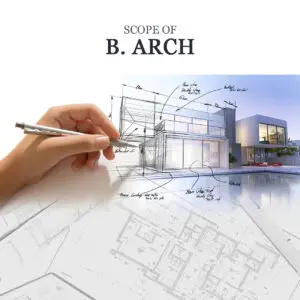
A Bachelor of Architecture program helps students develop this foundation. It trains them to think critically, observe human behaviour, understand urban challenges, create design solutions, and communicate ideas through drawings, models, software, and presentations.
Architecture education builds the ability to imagine better spaces and then convert those ideas into practical, buildable solutions.
Study B.Arch at OmDayal Group of Institutions
Students who want to build a career in architecture, smart cities, sustainable development, and urban design can begin their journey with the B.Arch program at OmDayal Group of Institutions.
OmDayal Group of Institutions offers B.Arch – Architecture, and its official admission page describes the institution as a pioneer in private-sector architectural education in West Bengal, supported by infrastructure, experienced faculty, and industry connections. The institution’s architecture department also highlights academic and research interests in urban planning, architecture, design, urban development, and infrastructure.
This makes the B.Arch program highly relevant for students who want to understand how buildings, communities, cities, and sustainability are connected.
Conclusion
The role of architects in smart cities and sustainable development is becoming more important every day. Architects are not just designing buildings; they are shaping the future of urban life. They are creating cities that are smarter, greener, safer, more inclusive, and more responsive to human needs.
For students who dream of contributing to this future, architecture offers a meaningful and future-ready career path. By pursuing the B.Arch program at OmDayal Group of Institutions, students can develop the design knowledge, technical skills, sustainability mindset, and urban understanding needed to become professionals who can help build better cities for tomorrow.
A smart and sustainable future begins with thoughtful design. And thoughtful design begins with the right architectural education.
FAQs
What is the role of architects in smart cities?
Architects design buildings, public spaces, housing, transport-related spaces, and urban environments that make smart cities more functional, sustainable, inclusive, and people-friendly.
How do architects contribute to sustainable development?
Architects contribute through energy-efficient buildings, green materials, water conservation, climate-responsive design, natural ventilation, solar planning, and better use of urban land.
Is B.Arch a good course for students interested in smart cities?
Yes. B.Arch helps students understand design, construction, urban planning, sustainability, and human-centric spaces, making it suitable for careers related to smart cities and sustainable development.
What career options are available after B.Arch?
After B.Arch, students can work as architects, urban designers, sustainable design consultants, interior architects, landscape designers, project planners, or pursue higher studies in urban development and planning.
Why choose OmDayal Group of Institutions for B.Arch?
OmDayal Group of Institutions offers B.Arch – Architecture with a focus on design education, infrastructure, experienced faculty, and an academic environment connected to architecture, urban development, and sustainability.